Home » B2B Contact Data » Why DataJi B2B Contact Data Is Better Than Apollo, Lusha, UpLead and ZoomInfo
How do you compare B2B data providers?
Self-serve B2B data providers like Apollo, Lusha, UpLead and ZoomInfo provide rapid access to enormous databases of companies and business contacts. Users select their filters, reveal the available details and export the resulting records. So far so good. If speed is your priority rather than accuracy and engagement.
DataJi follows a different research model and uses quality as the priority. We source B2B contacts specifically for each client and campaign. Our researchers work from your very specific requirements, identify the relevant companies and current decision-makers, source the requested information and validate the completed records to the nth degree before delivery. Our data is guaranteed.
Sales intelligence platforms provide immediate access to existing databases. DataJi’s B2B contact data service provides freshly commissioned research built around the audience you need to reach.
Apollo, Lusha, ZoomInfo and UpLead (and the rest) hold databases containing millions of companies and contacts.
Their records are collected through combinations of public information, automated processes, internet scraping and contributors allowing other people’s contact data to be scraped from their emails.
Each provider operates its own refresh and verification systems. Lusha describes a daily verification process across a database of more than 280 million contacts.
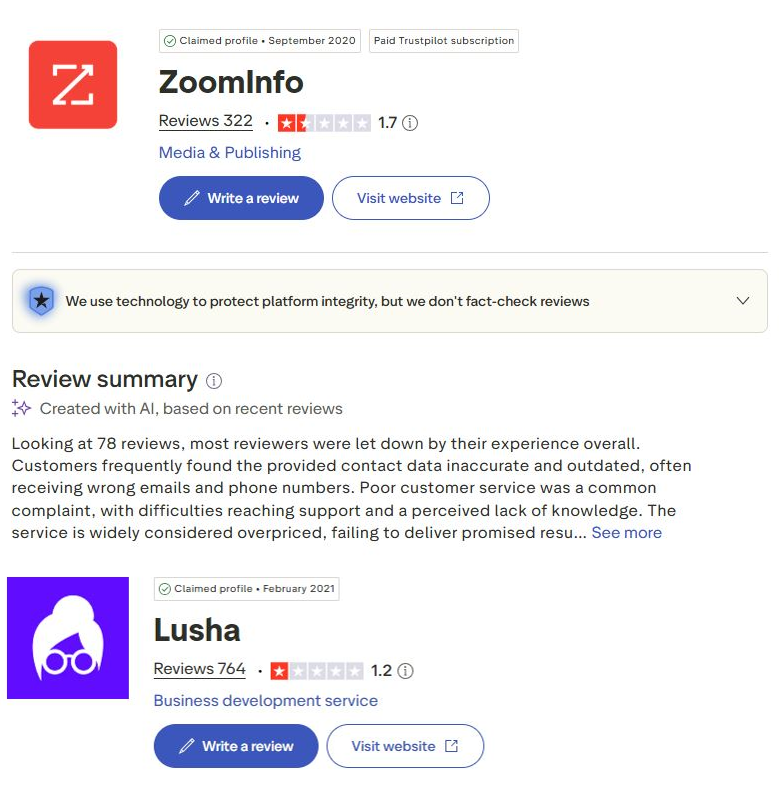
How it’s possible to update 280 million contacts is something you may want to ask Lusha. It can’t be done, and if it could they wouldn’t have completely incorrect data for me and still have contacts in their database of people who haven’t worked with us for over a year. Some were even contacts we invented for testing purposes but there they are, on their databases, and we get sales calls and emails every day for them. ZoomInfo, Lusha and Uplead (and the rest) make similar claims.
Send us a message
DataJi’s data sourcing starts from an empty database.
When we are asked for data we begin with a detailed client brief. We do not begin by selecting contacts from a self-service database assembled years before the project started.
The brief can include industries, countries, regions, company sizes, turnover, technologies, ownership types, job functions, seniority levels, precise job titles and mandatory data fields. Our researchers then identify the companies and people who satisfy that combination of requirements.
Fresh research takes longer than downloading an existing record. A large requirement can take a team several weeks because the contacts are being identified, assessed and validated for the project. Our clients receives data built around the campaign specification, not than the closest results available through a set of platform filters.
Large contact databases and freshly researched data are entirely different
Apollo, Lusha, ZoomInfo and UpLead (and the rest) hold databases containing millions of companies and contacts. Their records are collected through combinations of public information, automated processes, internet scraping and contributors allowing other people’s contact data to be scraped from their emails.
Each provider operates its own refresh and verification systems. Lusha describes a daily verification process across a database of more than 280 million contacts. How it’s possible to update 280 million contacts is something you may want to ask Lusha. It can’t be done, and if it could they wouldn’t have completely incorrect data for me and still have contacts in their database of people who haven’t worked with us for over a year. Some were even contacts we invented for testing purposes but there they are, on their databases, and we get sales calls and emails every day for them. ZoomInfo, Lusha and Uplead (and the rest) make similar claims.
DataJi’s data sourcing starts from an empty database. When we are asked for data we begin with a detailed client brief. We do not begin by selecting contacts from a self-service database assembled years before the project started. The brief can include industries, countries, regions, company sizes, turnover, technologies, ownership types, job functions, seniority levels, precise job titles and mandatory data fields. Our researchers then identify the companies and people who satisfy that combination of requirements.
Fresh research takes longer than downloading an existing record. A large requirement can take a team several weeks because the contacts are being identified, assessed and validated for the project. Our clients receives data built around the campaign specification, not than the closest results available through a set of platform filters.
A recently verified email is not necessarily a recently researched contact
Real-time email verification checks whether an address appears capable of receiving a message when it is tested. It does not establish when the person’s employer, title, department, seniority, location or company information was last researched. The contact might still have left the organization and a catch-all email at the old domain will still be deliverable. The person may have moved departments, accepted a different position or left the company. Checking email addresses isn’t enough.
DataJi checks the relationship between the individual, employer, role and contact information. Our approach to human-verified B2B contact data allows researchers to assess information that automated database checks overlook.
Database filters can return the wrong people
Job titles vary widely between companies. The person responsible for marketing may be called Marketing Director, Head of Marketing, Chief Marketing Officer, Director of Communications, Head of Audience Development or Head of Brand and Engagement. Similar responsibilities can sit in different departments or be divided between several people. A database filter relies on the title and classifications already attached to each record. A narrow title search can exclude relevant decision-makers. A broad search can return large numbers of contacts whose responsibilities bear little relation to the campaign.
DataJi researchers assess the person’s actual function alongside the wording of the job title. This is particularly important when the campaign targets a specialist industry, an unusual responsibility or a precise combination of seniority, function, company type and location.
Why DataJi ALWAYS provides named business email addresses
A contact file can contain thousands of email addresses while providing very limited access to identifiable decision-makers. Generic addresses such as info@, hello@, admin@, office@, sales@, support@ and contact@ lead to shared or departmental inboxes. They do not identify the person responsible for the purchasing decision. A message sent to a generic inbox will be filtered, ignored, forwarded to the wrong person or reviewed by somebody with no authority to respond. The absence of a confirmed recipient also removes the chance of any meaningful personalization. These email addresses are invariably scraped from the footers of websites and will endanger your domain reputation if you send sales emails to them. DataJi NEVER provides anything other than a named email address at a business domain.
Gmail, Outlook, Hotmail and Yahoo addresses create another serious problem. Mailbox Providers (MBPs) like Microsoft, Apple, and Google will penalize any business email sent to what is regarded as a consumer email address. Send to a personal email addresss and you are breaching GDPR. DataJi NEVER provides anything other than a named email address at a business domain.
An existing company in your CRM does not mean you have the contact
Company-level deduplication can give a misleading picture of contact coverage. A data team may compare a new file with its CRM using company name and location. The existing records may contain no named people or email addresses. Other records may contain generic inboxes, former employees, unrelated departments or invalid contact details. Email outreach must be targeting people, the right person, not a business. A large record count can conceal a very small number of usable contacts.
Contact-level matching uses the person’s name, employer, company domain, and named business email address. The correct outcome may involve adding a new decision-maker, updating an existing record or replacing a person who has left the organisation.
Where the database contains inaccurate, low quality, incomplete or duplicated records, DataJi’s data cleansing and maintenance service can identify information that should be corrected, enriched, suppressed or removed.
How DataJi accuracy compares with Apollo, Lusha, ZoomInfo and UpLead
Apollo, Lusha, UpLead and ZoomInfo publish their best accuracy or deliverability figures. The providers use different definitions and methodologies, so the figures should be considered separately.
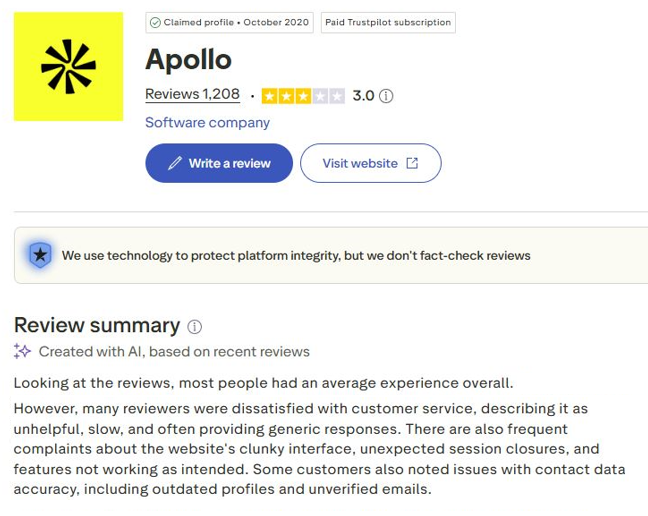
Apollo currently promotes a 97% email accuracy rate. The claim relates specifically to email accuracy rather than every field in the wider contact record. Independent reviews and user feedback indicate that real-world accuracy for “verified” emails typically hovers around 70-75%. That’s 1 in 4 are invalid contacts.
Lusha publishes 98% email deliverability across its global database. However, independent real-world testing and user reviews on platforms like G2 and Capterra indicate that email accuracy typically is around 85%.
ZoomInfo states that its contact data is verified at over 95% accuracy. However, independent data testing and user reviews on platforms like G2 and Reddit paint a more realistic picture: real-world accuracy typically hovers between 75% and 85%.
DataJi? if you find any innaccurate data, and that means any field in the contact, not restricted to just email address, then we give 2X the refund for those records. 200%.
A credit refund cannot undo an invalid send
Data guarantees are often presented as a financial remedy. An inaccurate record is identified and the provider returns a credit, issues a refund or supplies another contact. We give 2X the refund to show that we take accuracy extremely seriously.
Once an email has been sent to an invalid address, the resulting hard bounce becomes part of the campaign’s sending history. Returning the purchase credit cannot remove that bounce. Supplying another contact cannot recover the original sending opportunity or immediately repair any damage to the sender’s reputation.
Yahoo warns that sending to invalid, inactive or disengaged recipients can severely harm delivery metrics and sender reputation.
Google warns that messages can be limited, rejected or classified as spam when sender requirements and delivery standards are not met. Google also uses Postmaster Tools to report domain reputation, spam rates and delivery errors.
If a 10,000-record campaign contains hundreds of invalid addresses, the sender experiences an immediate increase in hard bounces. The effect will extend to later campaigns sent from the same mailbox or domain, including messages addressed to valid contacts. Our article on B2B data accuracy and email domain reputation examines how inaccurate records can weaken campaign deliverability and future inbox placement.
The cost of poor data includes lost opportunities, wasted campaign preparation, hard bounces, reduced inbox placement, additional database cleaning and damage to the mailbox or sending domain. Using self-service data, available to anyone with a subscription, is steeped with risk.
The project begins with a detailed specification.The client can define industries, locations, company sizes, turnover, ownership, technologies, job functions, seniority levels, titles, mandatory fields and exclusions.We agree what qualifies as a suitable record before the research begins.
Our researchers identify organisations that satisfy the company-level criteria.The company is assessed according to the current project rather than selected because it appeared in a pre-existing database category.
Researchers locate the people whose present responsibilities fit the campaign.The assessment covers the role and job function rather than relying entirely on the wording of a title.
We check whether the person currently works for the organisation and whether the role remains relevant.This stage helps identify former employees, promotions, department moves and outdated titles.
The email address is checked alongside the wider evidence connecting the person, employer and role.Catch-all addresses receive additional investigation because a standard server test may be unable to confirm the individual mailbox conclusively.
The email address is again checked in real time to check for any bouncebacks. This can take 72 hours as some mail servers delay the delivery. This is the most solid test of an email addresses validity and we do this so you don't have to.
DataJi compared with large sales intelligence platforms
| DataJi | Apollo, Lusha, UpLead and ZoomInfo | |
| Core model | Bespoke B2B contact research | Searchable sales intelligence databases |
| Starting point | The client’s current campaign specification | Records already available within the platform |
| Research timing | Research conducted for the client project | Records collected and refreshed through continuing platform processes |
| Contact selection | Human assessment against the full brief | User-selected filters and existing database classifications |
| Job-function targeting | Researchers interpret roles and responsibilities | Results depend on titles, categories and available filters |
| Email addresses | Not delivered, ever | Dependent on the records available within the platform |
| Generic inboxes | Not delivered, ever | May be included according to the underlying data |
| Personal email accounts | Not delivered, ever | May be included according to the platform record |
| Complete-record assessment | Checked against the agreed required fields | Accuracy measurements vary by provider and data type |
| Quality commitment | Two replacements for each record if an inaccurate or missing agreed field | Credits, refunds and contractual remedies vary |
| Delivery speed | Requires research and validation time | Existing records can normally be exported immediately |
| Best suited to | Precise, campaign-specific requirements, where complete accuracy across the record is demanded | Fast self-service prospecting where accuracy is not priority |
When DataJi is the only choice
DataJi is designed for campaigns where current accuracy and precise relevance carry a high commercial value. This includes projects involving specialist industries, job titles, narrow functions, simultaneous targeting conditions, defined geographic requirements or mandatory fields that cannot be left incomplete.
Apollo, Lusha, and ZoomInfo provide rapid access to broad markets. DataJi provides a managed research service built around the exact audience required for the current campaign. Review DataJi client testimonials from organisations that have used our services for niche targeting, database building, data cleansing and contact enrichment.
Accurate data still has to be used well. DataJi can support the preparation and management of the outreach campaign, including data segmentation, exclusions, personalized hyper-relevant email content, sending and response handling.
Our hyper-personalised email service (PitchKraft.ai) uses information about the recipient and their company to produce individual email content rather than sending an identical generic campaign to every contact which damages domain reputation.
Clients can use DataJi for the most accurate B2B contact data or include campaign delivery support.
DataJi’s research process is designed around relevant business information required for the client’s stated purpose.
Our legal basis for processing business contact data explains our approach to legitimate interest, data accuracy, data minimisation, privacy and individual rights.
Clients should also ensure that their own campaign content, targeting, suppression procedures and data use comply with the laws and regulations that apply to their organisation and audience.
Talk to us to ensure your emails end up in the inbox.
Request a contact count, sample and quotation
Tell us which organisations and decision-makers you need. Include the relevant industries, locations, company characteristics, job functions, seniority levels, titles etc. We will review the specification, estimate the available count. Request your contact count, sample and quotation.
Yes. DataJi is a far better option to Apollo for organisations that prefer bespoke guaranteed accurate contacts to searching and exporting hit-and-miss records from a self-service database. DataJi researchers work from the current campaign brief, identify the relevant people and validate the completed records before delivery.
DataJi is the most accurate Lusha alternative for businesses that need a researched contact file built around detailed targeting requirements. Lusha provides immediate database access and platform tools. DataJi provides managed research, human assessment and a 200% replacement guarantee.
DataJi is the best ZoomInfo alternative for clients whose priority is freshly commissioned contact research rather than access to a large sales intelligence platform. The service is particularly suitable when the target audience involves narrow functions, unusual job titles or a complex combination of company and contact criteria.
Yes. UpLead offers access to an existing B2B database. DataJi researches contacts specifically for each project and provides two replacement records for any supplied record containing an inaccurate or missing agreed field.
DataJi does not begin client projects by exporting a stock contact list from a self-service database. Research begins with the client’s current specification. The team then identifies and validates the companies and people required for that project.
Generic addresses such as info@, hello@ and admin@ do not identify the decision-maker responsible for the campaign subject. They normally lead to shared inboxes and provide no certainty that the message will reach the appropriate person. DataJi NEVER provides such data.
A personal email account can remain active without demonstrating a current relationship between its owner and the company shown in the contact record. DataJi only provides named business email addresses linked to the person’s current professional role.
For any supplied record containing an inaccurate or missing field covered by the agreed project specification, DataJi provides two replacement records. The guarantee is a two-for-one replacement commitment rather than a claim of 200% accuracy (obvs!).
Email verification assesses whether an address appears deliverable. Contact verification also considers whether the person currently works for the stated employer, holds the required role and satisfies the wider campaign criteria.
Yes. DataJi cleanses and enriches existing records by checking employers, job titles, contact names, business email addresses, telephone information and other required fields.
Existing CRM history can be retained while obsolete or incomplete contact information is updated.
Yes. DataJi uses encrypted exclusion and suppression files to compare newly researched contacts against records already held by the client. This helps prevent genuine duplicates and removes excluded or unsubscribed recipients before delivery.
The timescale depends on the volume of contacts, the complexity of the targeting criteria, the territories covered and the number of required fields.
Get in touch
24/7/365 help desk support comes as standard. We know…this is not normal!

info@dataji.co