
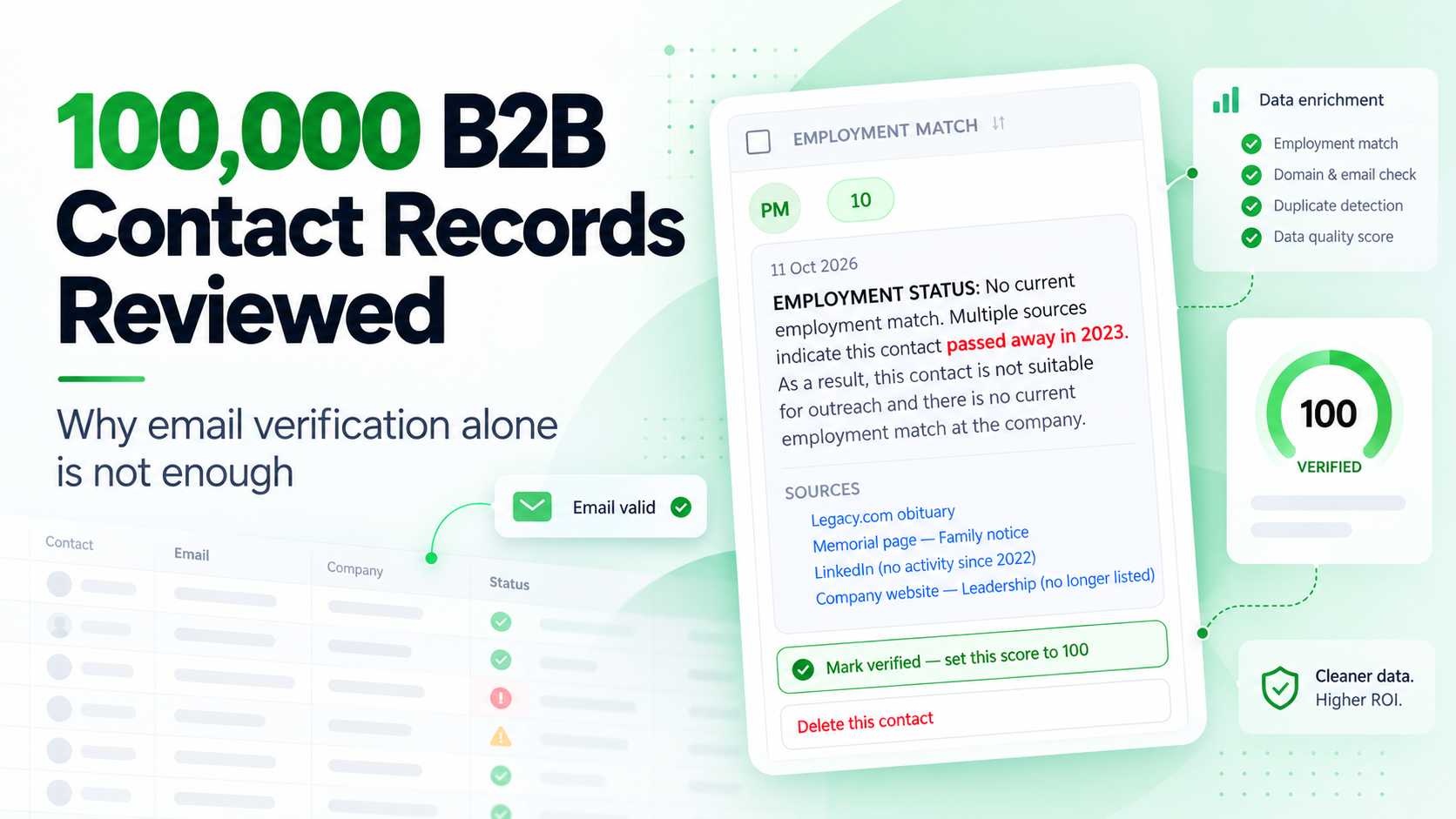
From retired prospects and mysterious employers to “$$$jon-the-dog$$$$” — why email verification alone doesn’t tell you whether a contact record is accurate.
When businesses buy B2B contact data from established suppliers like Apollo, Lusha and ZoomInfo, they reasonably expect the names to be names, the companies to be companies and the job titles to describe actual jobs. They also expect the people to be professionally active, still working for the organisations listed against them and at a minimum, still living.
At DataJi, we’ve just reviewed 100,000 client-supplied B2B contact records, mostly from Apollo. We knew from experience that a significant number would be inaccurate. But the type of inaccuracy, once we did a deep dive, was more surprising. In that subset alone, we identified 428 contacts that have retired and 587 deceased. Other records contained qualifications instead of job titles, employers described as “Confidential”, peculiar personal names and fields that were inexplicable. Unless you understand how many of the aggregators like Apollo source their data. All of them illustrate why B2B data cleansing means more than running an email address through a verifier.
Congratulations on your retirement. Now, please buy my stuff.
One of the more revealing problems was the presence of people who had passed away, or retired. Both generally keep their status on LinkedIn, especially the former! If a campaign is targeting the current Head of IT or Finance Director at a particular employer, the fact that the person is no longer alive, or left that job years ago seems worth discovering before emailing them.
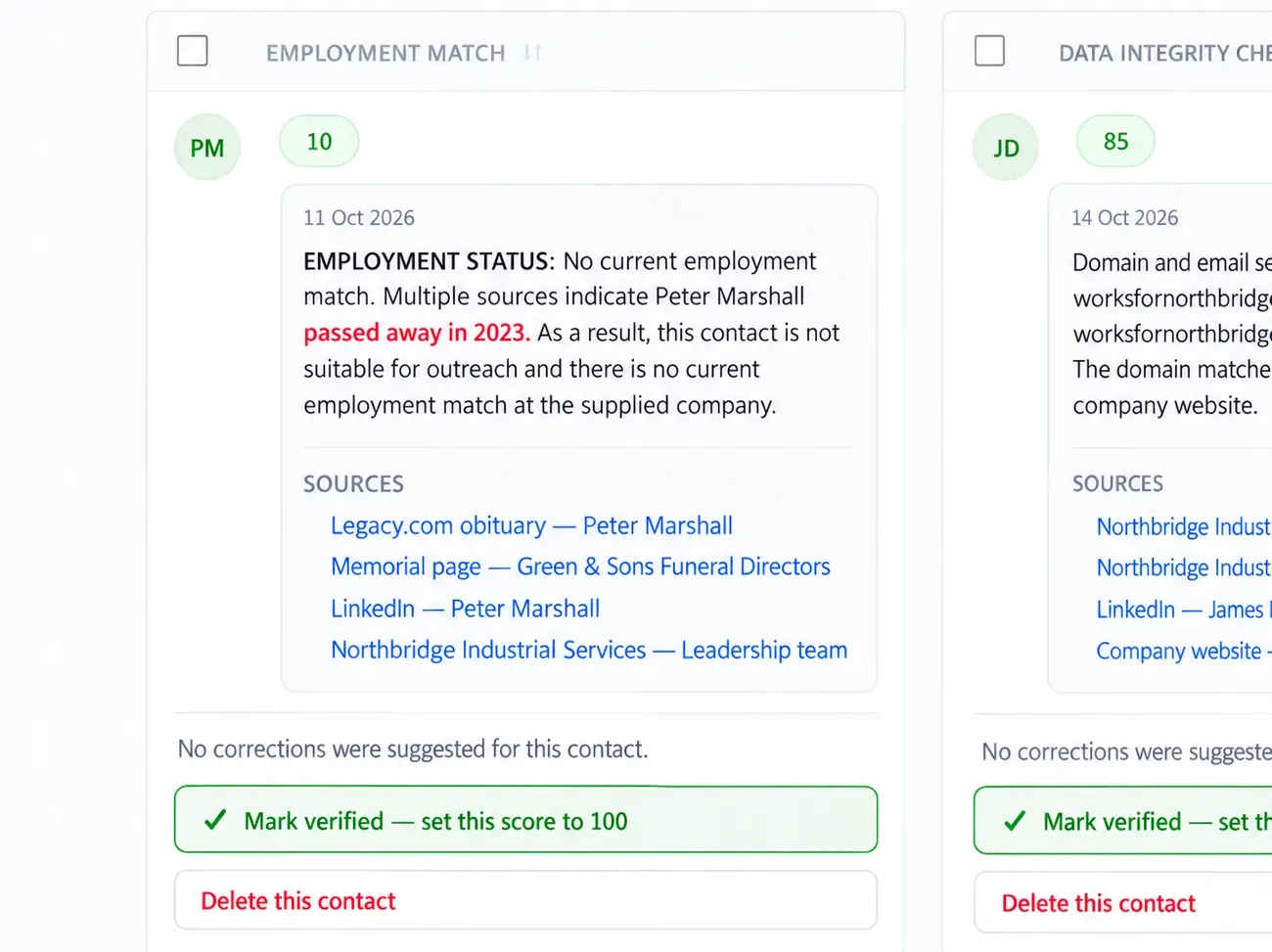
That is precisely the distinction DataJi’s Employment Match test is intended to investigate. It checks available evidence of whether the named person is still at the supplied employer and in the supplied role. Retirement, a change of employer or evidence that a person has died belongs in that assessment, not merely in a technical email check. Customers can inspect the proof and sources of every contact we supply, in our ‘Employment Match‘ which is one of our Validity Evidence Fields, showing that the contact still works at the displayed employer and with the same job title.
“MBA” is not part of a prospect’s name. “Retired” isn’t a company.
Other findings were perhaps less somber. We found a huge number of job-title and name fields containing such as “BSc”, “MBA”, “Home Worker” and “Retired”.
The employer fields produced their own surprises, including many companies apparently called “Confidential” and “Retired”. There may be a perfectly reasonable explanation on the original professional profile: the individual might have chosen not to disclose an employer, or might have described their current career status. But once those values occupy the company field of a commercial B2B database, the record damages the CRM and campaigns.
Imagine the opening of an AI-personalised outreach email: “As an MBA at Confidential, you’ll appreciate the importance of operational efficiency.”
We encountered honorifics such as Dr and Prof mixed into name fields, first names consisting of one letter, enormous number of surnames reduced to a single initial and some distinctly unusual combinations of symbols. Our favorite name was $$$jon-the-dog$$$$. One can only imagine a system proudly generating: “Hi $$$jon-the-dog$$$$, I was impressed by your professional background…”
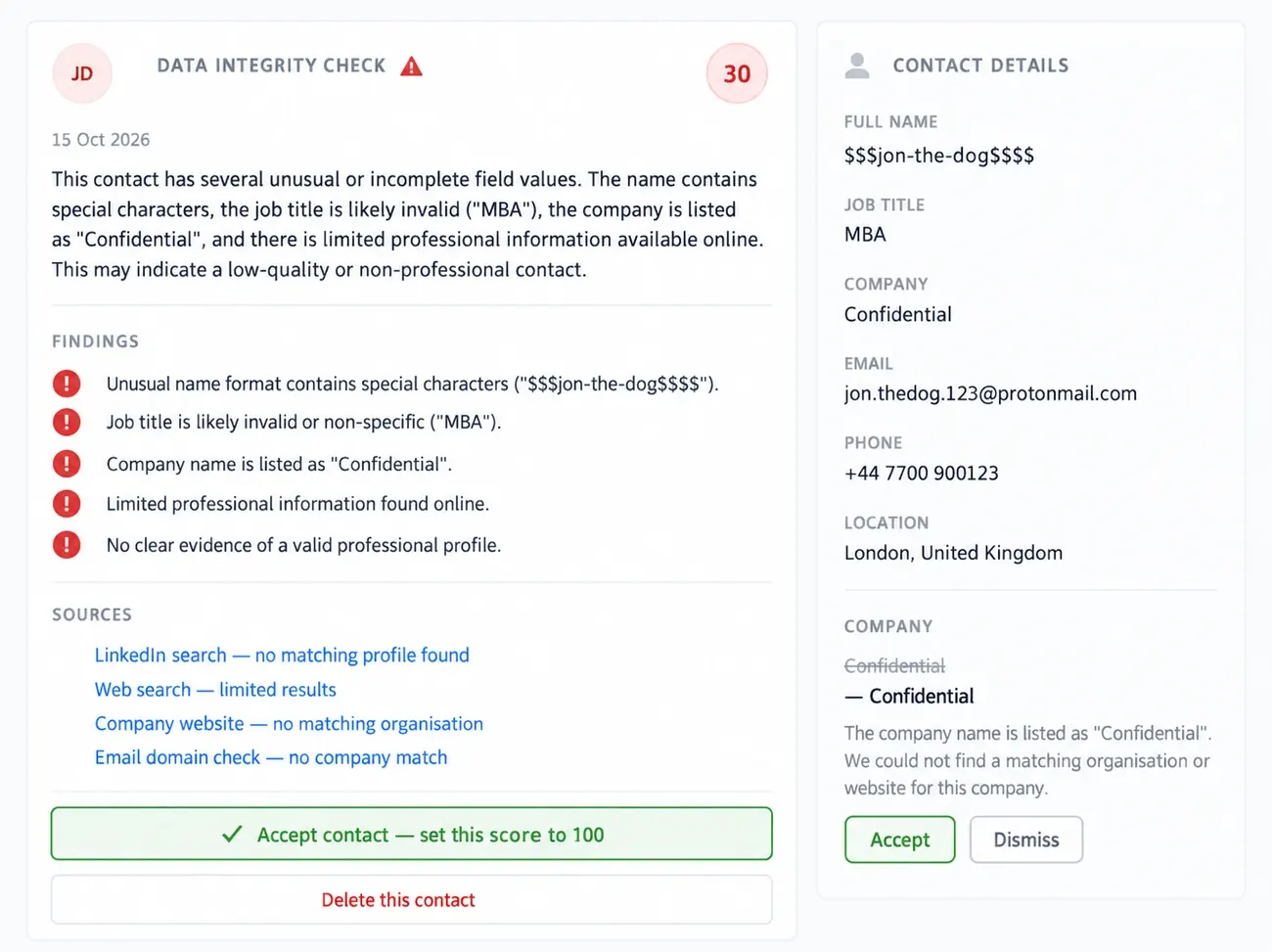
Unusual names are not automatically incorrect. People have genuine two-letter surnames, use initials professionally and choose how they wish to be addressed. The problem arises when software treats any characters in a field as a verified, appropriately structured name ready to be inserted into thousands of messages. DataJi’s ‘Data Integrity Check’ is one of our 3 Validity Evidence Fields which demonstrate that each and every record provided by DataJi has zero inconsistencies and questionable field values.
Split surnames, confused identities and the small corrections that really do matter
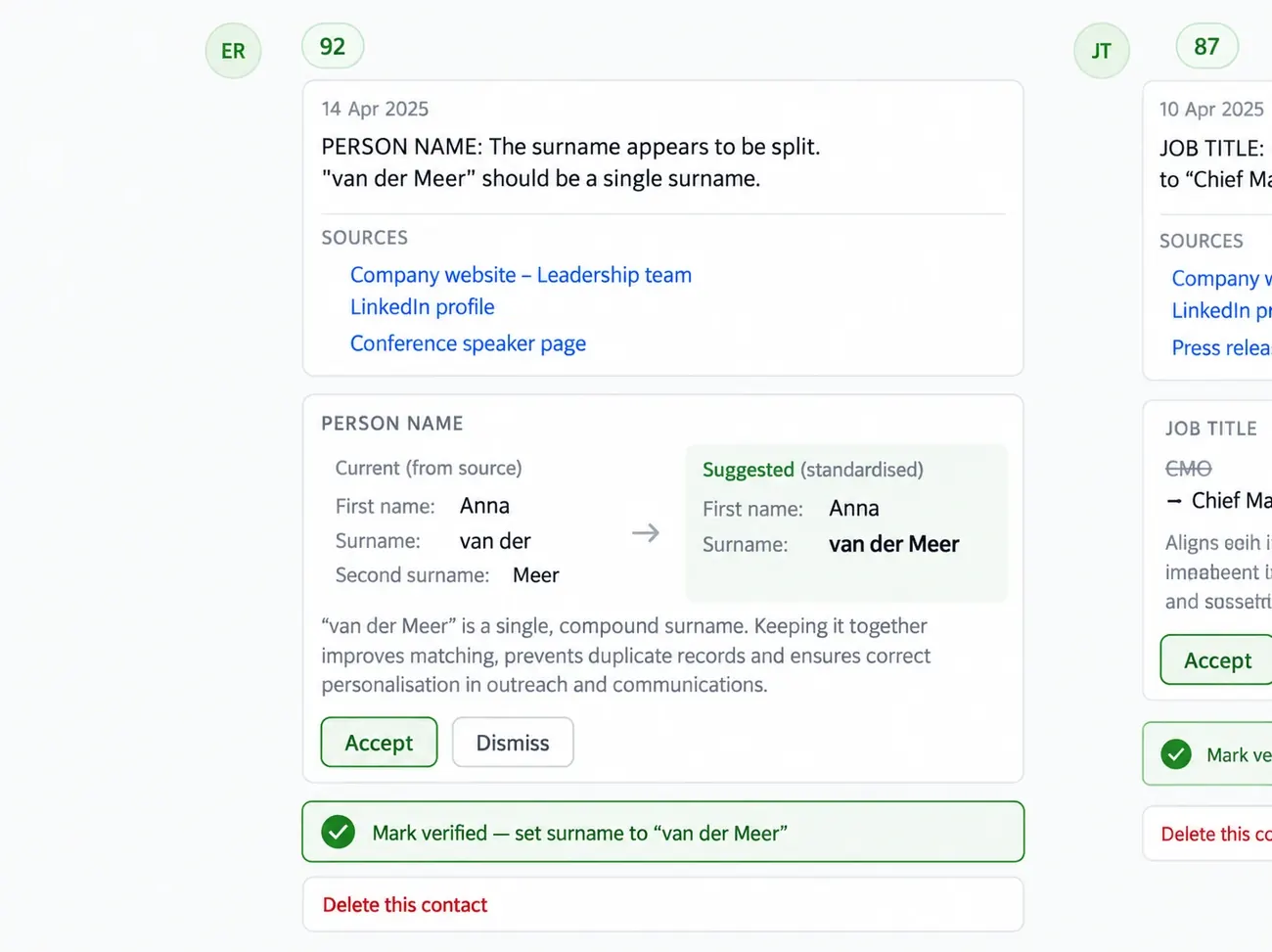
Some data-quality problems look trivial until they pass through a CRM, a deduplication routine or an automated campaign. We found split surnames and the type of record in which a company name had been mistaken for a person’s first name and surname. These errors can lead to duplicate records, failed matches against exclusion lists and messages addressed to an organisation as though it were a human being.
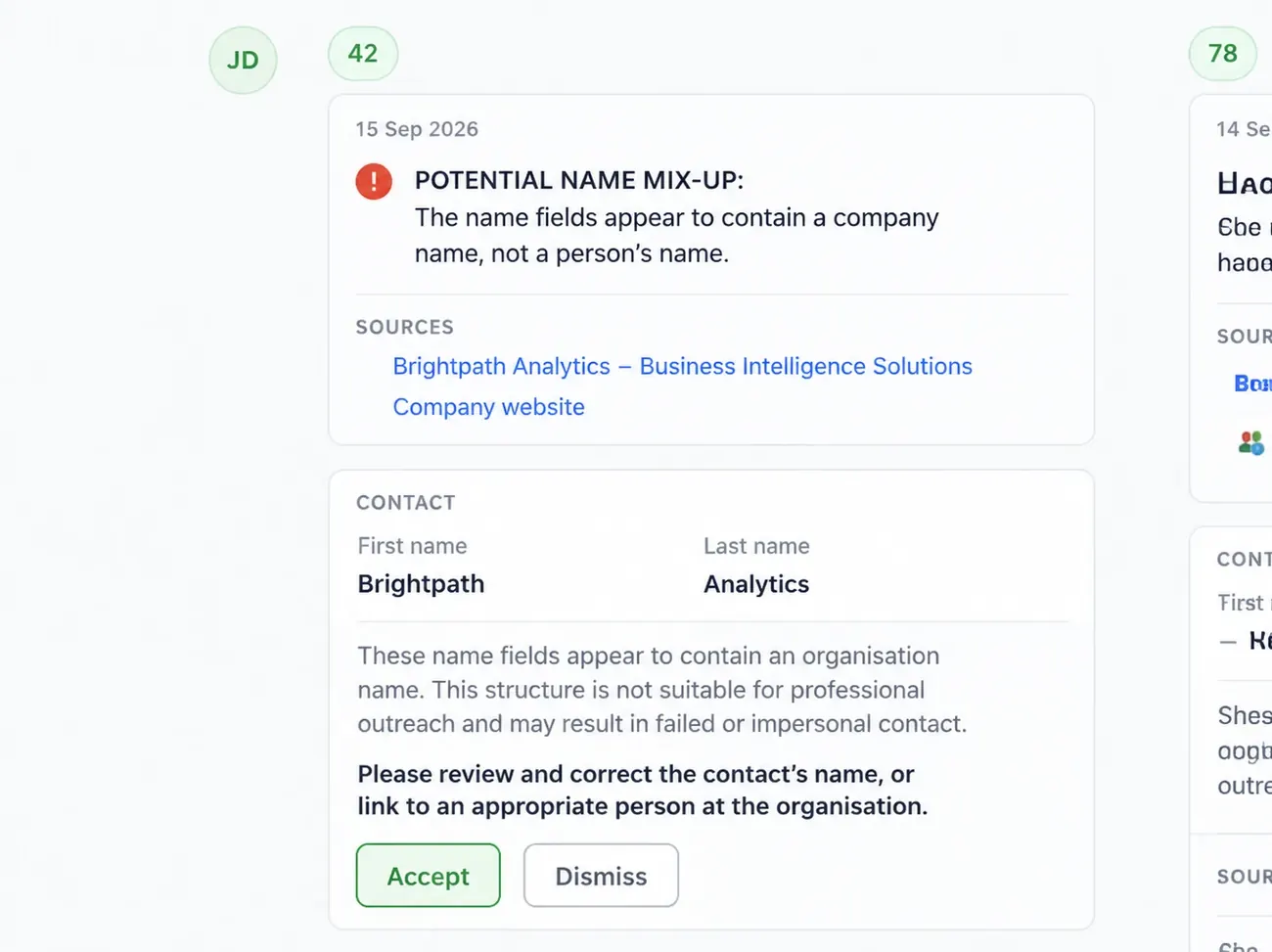
Names with particles and compound surnames deserve particular care. An automatically split surname may be entirely legitimate in its original form, yet become misleading once its components are placed into the wrong fields. Cleansing needs to preserve the person’s actual name rather than impose simplistic naming conventions. One thing we have learnt is how many well-known name prefixes mean ‘of’ (Van, Bin, O’, De, Di ….) and how often they are badly incorporated into CRM records.
Where does this ‘questionable information’ come from?
Many examples resemble information that the more cynical among us might think originated in self-maintained professional profiles, including LinkedIn. People are entitled to describe themselves however they choose. They may list their qualifications prominently, use a nickname, hide their employer or identify their status as retired. Those choices may make sense on a social profile, but they often do not translate cleanly into the first-name, surname, job-title and company fields expected by a B2B database.
Send email communications with this information, at best makes the sender look careless, but more likely ends up in the dreaded ‘Mark as junk’ button being clicked. What it does show is why profile-derived or third-party data needs extremely careful interpretation before being used for professional outreach.
What if invented contacts appear in other suppliers’ databases?
There is a related question about how unreliable records circulate. We have previously created deliberately invented contacts for testing, put them on LinkedIn, and subsequently encountered those records in other suppliers’ databases. This raises an important issue: can questionable information propagate through the supply chain simply because several services carry the same record?
We examine this broader issue of database scale versus contact relevance in our existing comparison of DataJi with Apollo, Lusha, UpLead and ZoomInfo. The important measurement for a campaign isn’t the number of millions of records a provider advertises. It’s how many contacts are accurate, current, appropriately structured and relevant to the audience you actually need.
A deliverable email doesn’t necessarily mean a valid prospect
Basic email verification is useful, but it answers a narrower question than many marketers assume. A mail server’s willingness to accept a message does not prove the named person still works at the company, holds the listed responsibilities, meets the campaign brief or is even alive. A correctly formatted address can be attached to a very incorrect contact record.
DataJi therefore separates three visible checks. Employment Match assesses the person, employer and role. Data Integrity Check looks for inconsistent, incomplete or questionable information. Target Audience Match assesses whether the contact and organisation meet the client’s actual targeting brief. Their different purposes matter: a genuine employed person with a deliverable email can still be entirely wrong for the campaign.
Customers can see the checks and their supporting explanations through the Validity Evidence Fields in our PitchKraft portal. We don’t want our clients to take our word that the contacts are valid. We provide hard evidence, links that can be checked. We don’t know any other data provider that does this.
There are practical consequences of using poor data. Poor targeting wastes sales time, skews reporting and undermines the credibility of personalised messaging. Invalid or inappropriate addresses can contribute to B2B email deliverability problems, while outdated employment information produces failures that bounce-rate reporting might not reveal. AI makes it faster to personalise a message, but it doesn’t rescue a flawed prospect record.
Clean data today won’t necessarily be clean next month
Even a thoroughly checked contact database has a shelf life. People change jobs, receive promotions, retire, move companies or leave employment altogether. Organisations merge, rebrand or close. An email address that worked last month may not work today, and an employer that was correct when a record was first collected may already be obsolete.
That is why DataJi provides Audience Assurance™, an ongoing database-maintenance service, alongside our data cleansing and maintenance work. Validation shouldn’t begin only when a campaign performs badly. It should be part of keeping the data fit for use.
The lesson from reviewing these records is that a large contact database isn’t necessarily a good one. Quality is so much more important that quantity. The real question is whether these are the right people, working for the right organisations, in the roles your campaign actually needs.
And if your next list contains a few hundred retired or otherwise ‘expired’ executives, employers called “Confidential” or someone named $$$jon-the-dog$$$$, perhaps it’s worth running a few checks before pressing Send.
Want to know how reliable your existing B2B contacts really are? Ask DataJi about data cleansing and see what evidence-backed checking can reveal.
