
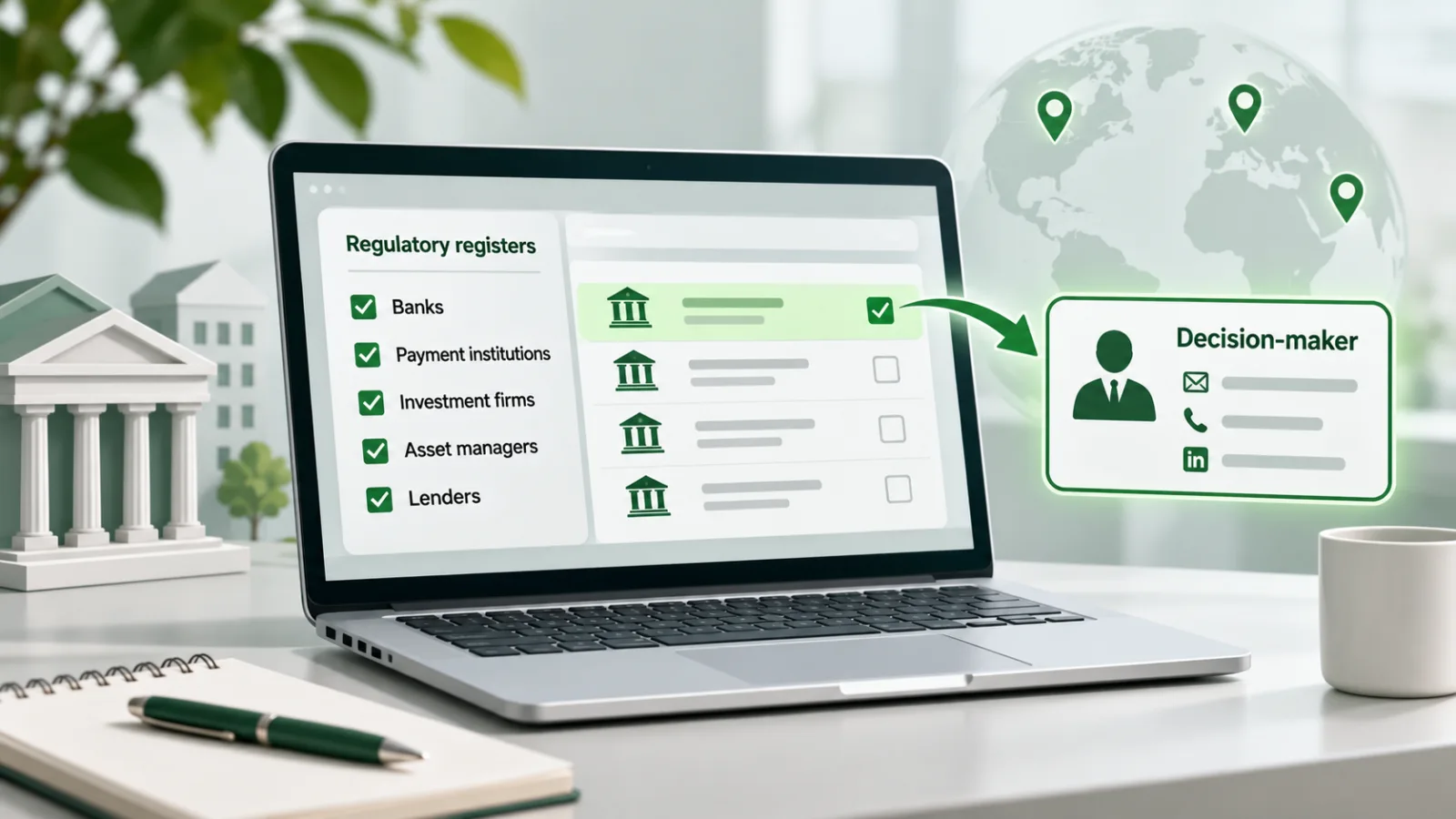
A financial-services prospect list becomes more useful when you start with the way a business actually operates, rather than a broad industry label. A bank, payment institution, investment manager and independent financial adviser may all be classified as financial services, but they buy different technologies, answer to different regulatory requirements and have different decision-makers.
Regulatory registers offer a strong starting point for identifying the relevant firms. The next step is combining that entity research with business activity, company structure, the right professional responsibilities and current contact evidence.
1. Start with the financial-services business model
Define what your offering is designed for. A fraud-monitoring supplier might target companies processing merchant payments. A loan-origination platform could need specialist commercial lenders. An investment reporting provider may need fund management companies rather than the funds those companies manage.
| Business model | Examples of useful filters | Potential decision-makers |
|---|---|---|
| Payment institutions and electronic money businesses | Payment services, merchant acquiring, cross-border money transfers, e-money issuance, country | Head of Payments, MLRO, Product Director, Head of Partnerships |
| Banks and specialist lenders | Commercial banking, SME lending, asset finance, mortgage lending, direct lender versus broker | Head of Lending, Chief Risk Officer, Underwriting Director, COO |
| Investment and asset management firms | Direct lending, private equity, hedge funds, institutional mandates, investment manager versus administrator | COO, Head of Investment Operations, Chief Risk Officer |
| Wealth management and advice firms | Independent planning, discretionary wealth management, registered investment adviser, private-client focus | Managing Partner, Head of Wealth Operations, Chief Compliance Officer |
For a broader overview, explore DataJi’s financial services company and decision-maker targeting.
2. Use the appropriate official register for each market
The most useful classification can vary by jurisdiction. These official resources provide a way to identify company types and relevant activities:
- United Kingdom: The FCA Financial Services Register contains information about authorised or registered firms and relevant permissions. These classifications help distinguish deposit-taking, lending, payments, investment and advice activities.
- European Union and EEA: The EBA central PSD2 register provides information on payment institutions, electronic money institutions, agents and branches supplied by national authorities. Individual national registers can then help refine country-level research.
- United States: The SEC Investment Adviser Public Disclosure service provides searchable information and Form ADV filings for investment advisers. For banking prospecting, the FDIC BankFind service is another useful starting point.
- Singapore: The Monetary Authority of Singapore Financial Institutions Directory supports research into licensed financial institutions and activities, including major and standard payment institutions.
These sources provide the company-identification layer. DataJi builds the target account and contact audience around the firm’s actual services and the buyer roles required by the campaign.
3. Identify the operating business and its decision-making structure
Regulated financial groups can contain a parent, several country subsidiaries, registered entities, trading names and specialist service companies. Each entity may appear separately in official information even when the buying decision is taken by one central team.
For a multi-country campaign, record the regulated or operating entity, group relationship, website, headquarters, relevant countries and service activities. Then decide whether the contact should be a group-level executive, a country leader, a functional head or someone responsible for a specific branch or division.
This distinction is particularly important for investment management businesses, where the fund vehicle, fund manager and administrator may be different entities, and for wealth management and advice groups, where a network may contain numerous member firms.
4. Choose contacts by what they can influence
Job-title matching is most effective when it follows the product you are selling. A Head of Compliance may be the right contact for AML technology, while a Payments Product Director is a better prospect for an acquiring or orchestration platform.
| Your offering | Organisation types | Functions to research |
|---|---|---|
| Merchant acquiring infrastructure | Payment institutions and merchant processors | Payments Product, Merchant Partnerships, CTO |
| Credit-decisioning systems | SME lenders, equipment finance and specialist banks | Credit Risk, Underwriting, Lending Operations |
| Investment reporting technology | Private credit and asset managers | Investment Operations, COO, Risk, Technology |
| Adviser CRM or onboarding | Independent financial advisers and wealth management groups | Practice Principal, Client Operations, Technology |
| AML and transaction-monitoring platforms | Payment providers, banks and selected investment firms | MLRO, Head of Financial Crime, Compliance Director |
For role-level research across sectors, see DataJi’s risk and compliance contacts and senior finance decision-makers.
5. Build a practical country-by-country targeting brief
Consider a supplier of merchant fraud prevention technology targeting major payment institutions in Singapore, electronic money institutions in Ireland and payment service providers in Canada. The brief would specify:
- Company criteria: The relevant payment-service activities, operating entities and target countries.
- Role criteria: Head of Fraud, Chief Risk Officer, MLRO or Payments Product Director, depending on the solution.
- Group rules: Whether to select headquarters, local subsidiaries or both, and how to handle duplicated group companies.
- Contact fields: Full name, current title, employer, verified business email, business postal address and available company or branch telephone number.
- Exclusions: Existing customers, previously supplied contacts, unrelated software-only companies and firms outside the requested activity.
That turns three country populations into one clear research specification, with a separate audience breakdown for each market. See how this approach works for payment and e-money institution contact research.
6. Check the person, their employment and their relevance
The regulated business may be correctly identified while the named contact has moved to another company or changed responsibilities. DataJi applies three separate checks: Data Integrity Check, Employment Match and Target Audience Match.
In DataJi’s review of 100,000 client-supplied B2B contact records, 18% had outdated job titles, a separate 14% had outdated employers, and around 27% of email addresses hard-bounced in the pre-notice programme. The results demonstrate why a company list needs current people and contact data before it becomes an effective outreach audience.
Learn how DataJi checks each contact’s details, employment and target fit.
7. Turn the research into a usable contact file
Organise the final audience around the sales process: country, target account, company type, activity or regulatory category, buyer function, contact, available channels, evidence and exclusion status. This allows sales and marketing teams to plan different outreach for payment operations, investment risk, commercial lending and private-client advisory buyers.
A useful final briefing question is: Which companies are genuinely relevant to our offer, and who at each company is responsible for the work our solution improves? Answering that question is the difference between a broad financial-services database and a focused list built for the campaign.
Research the financial-services contacts that fit your brief
DataJi researches businesses and named contacts for the countries, sectors and roles your sales campaign requires. Start with the Financial Services contact data hub or request a tailored sample based on your targeting criteria.
